History of the labyrinth
Many people are discovering labyrinths today. Althought labyrinths have existed for centuries to a lot of people labyrinths and labyrint walks are new topics to discover.
I've noticed it when talking about our Equinox labyrinth walk with people in my neighborhood and even with friends, that to a lot of people this seems very strange, odd and even uncomfortable.
So maybe a little history could help us realize that labyrinths have been around for a long, long time...
***************************************************************************
Labyrinths and mazes
"Mazes are places where one gets lostLabyrinths are places where one is found..."
 Mazes and a range of labyrinth designs are found all around the world in many cultures and civilizations. They are found carved in rock, ceramics, clay tablets, mosaics, manuscripts, stone patterns, turf, hedges, and cathedral pavements. The earliest known designs are about 3000 years old. The significance of them for the various cultures they were part of and the story of how they developed from one place to another (or simultaneously appeared in several) is often mysterious and hard to fathom. The most ancient and widespread design looks complicated but can be drawn quite easily if you know the method.
7-Fold Cretan Labyrinth

Cathedral Labyrinths
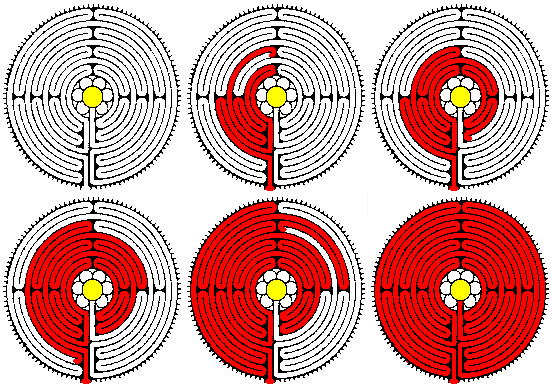 The Romans adapted the ancient labyrinth symbol as a decorative floor pattern, and the Christian artists and thinkers of early medieval times developed the Roman pattern into a new and beautiful form which was used as a feature in many medieval cathedrals. It was marked out on the floor in coloured stone or tiles and usually between 10 and 40 feet in diameter. A range of designs were explored, but the pattern used at Chartres Cathedral in northern France is the archetype and perfection of all medieval labyrinths
Chartres Cathedral, about 1750, Jean Baptiste Rigaud
The best known example of a labyrinth is embedded in the stone pavement of Chartres Cathedral
near Paris. The Middle Ages was a time of pilgrimages. Since most people could
not make the grand pilgrimage to Jerusalem, considered by Christians to be the
center of the world, and symbolizing the Kingdom of Heaven, they would make
pilgrimages to important cathedrals such as Canterbury, Santiago de Compostella
and Chartres. Once there, they would end their pilgrimage by walking the
labyrinth to the center, and then slowly retracing their steps to regain the
'outside world' and return to their homes. People believed that if you walked the labyrinth with the full
dedication of a pilgrim, you would be transformed, the old you will be grounded
at the threshold stone a purified you emerging, ready to tackle new directions
in your life's journey.
The new Cathedral labyrinth patterns were all laid out according to the same
basic pattern twelve rings that enclose a meandering
path which slowly leads to a center rosette. The path makes 28 loops, seven
on left side toward the center, then seven on the right side toward the center,
followed by seven on the left side toward the outside, and finally seven on the
right side toward the outside terminating in a short strait path to the rosette.
Like all cathedral labyrinths, it draws upon the ancient northern Celtic,
middle eastern, and Classical Greek and Roman origins of the Christian faith.
The Medieval builders were careful to incorporate their understanding of sacred
architecture into the design and location of the labyrinths, which were usually
placed near the entrance at the west end of the nave, beside the baptismal font
at the foot of the Church. This location symbolizes our first steps on the
spiritual journey.
Modern Labyrinths
In recent years, there has been a resurgence of interest in the labyrinth symbol, which has inspired a revival in labyrinth building, notably at Willen Park, Milton Keynes; Grace Cathedral, San Francisco; Tapton Park, Chesterfield; and the Labyrinthe de Harbor 16 in Montreal. Countless computer games depict mazes and labyrinths, e.g. the Lara Croft series. On bobsled, luge, and skeleton tracks, a labyrinth is where there are three to four curves in succession without a straight line in between any of the turns.
******************************************************************************************
In the summer of 2012 I visited Chartres Cathedral together with my family. It was wonderful to be there, walk there, contemplate there and to be still...
Unfortunately the labyrinth was covered with chairs. We learned that the labyrinth walk is only open once a month to the public. But to be there in that sacred space was a blessing in itself!
Next time I will focus on the 'Man in the Maze' labyrinth of the Hopi Indians and the labyrinths in Arizona.
Modern Labyrinths
In recent years, there has been a resurgence of interest in the labyrinth symbol, which has inspired a revival in labyrinth building, notably at Willen Park, Milton Keynes; Grace Cathedral, San Francisco; Tapton Park, Chesterfield; and the Labyrinthe de Harbor 16 in Montreal. Countless computer games depict mazes and labyrinths, e.g. the Lara Croft series. On bobsled, luge, and skeleton tracks, a labyrinth is where there are three to four curves in succession without a straight line in between any of the turns.
******************************************************************************************
In the summer of 2012 I visited Chartres Cathedral together with my family. It was wonderful to be there, walk there, contemplate there and to be still...
Unfortunately the labyrinth was covered with chairs. We learned that the labyrinth walk is only open once a month to the public. But to be there in that sacred space was a blessing in itself!
Next time I will focus on the 'Man in the Maze' labyrinth of the Hopi Indians and the labyrinths in Arizona.
